
Creating the innovation edge
How a 400 year-old recipe still has a lot to teach us

Have you ever wondered why we say ‘two heads are better than one?’
Mainly because in innovation we’ve learned that the lone genius is a pretty rare animal - we’re actually much better at coming up with new stuff if we collaborate. But here’s the interesting thing - it’s not just doubling our brain power when those two heads work together; the real value comes when they are different heads, bringing different stuff to the ideas party.
Which is what today’s post is all about.
(if you’d prefer to watch/listen please click here)
Valyrian steel from Game of Thrones. Andúril from Lord of the Rings. Excalibur rising from the misty lake to find its way into King Arthur’s hand. We love the myth of the lone, magical elven smith hiding in a mountain forge, infusing magic into metal.
But what if I told you the greatest steel in human history—metal that could bend in a semi-circle without breaking—was completely real? And it wasn’t made by elven magic, but by three completely different cultures sharing a city? A place you could call the Silicon Valley of the 16th century. The city of Toledo, in Spain.
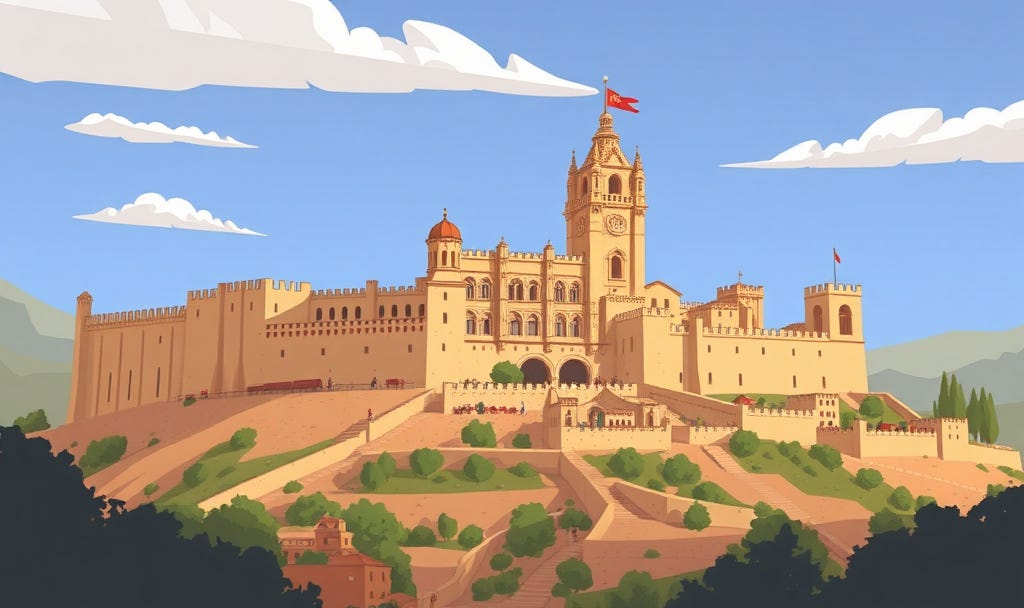
I actually met Don Quixote last week.
Or at least, I think it was him.
Mind you, it was a little hard to tell, me being whisked at 200 km/hour across the plains of La Mancha courtesy of the impressive high-speed train from Barcelona. All I really caught out of the window was the endless Spanish countryside, shifting in character like a slow wide shot in a movie. Red earth, olive trees — and a glimpse of a shadow on a horse with someone else by their side. Maybe a windmill — or was that just my imagination?
So it wasn’t hard to conjure another scene from the possible past, this time catching the glint of polished breastplates as the sun caught the progress of a troop of 16th century Spanish cavalry cresting the ridge up ahead. Their weapons, swinging loosely as they trotted purposefully across the rocks, sheathed in ornate leather scabbards, pecked with jewels which sparkled through the dust.
Not just any weapons. These were the swords which built a global empire. Blades so sharp, and so resilient, that they belong alongside their mythical cousins like Excalibur or Anduril.
Legendary blades - but these are not the product of fiction. Instead they were born not far from where my train was scything its way across southern Spain. In the smoky, sun-baked forges of a single city lying by the side of a river. Toledo — the fortress town which gave birth to a steel like no other.
Its reputation spread around the world; Japanese Samurai masters sought after the secret behind its blades, the conquistadores used them to devastating effect throughout Latin America, and the feared tercios of the Spanish infantry fighting their way through Europe had come to depend on it. And, like Swiss watches or luxury cars today, Toledo steel blades were the item no wealthy aristocrat could be seen without at his belt when posing for the official portrait.
Like good businessmen, the smiths of Toledo played up the mythology which had grown up around their workmanship. The magical waters of the river Tagus, somehow bestowing special power, marking out the difference between good blades and the legendary Toledo variety.
The reality was, of course, a little different — and a fascinating story of how innovation happens.
Once upon a time…
How did those Toledo craftsmen help the Spanish Empire rise to be the great Imperial power of its time? By solving a blacksmith’s ultimate dilemma: making a blade hard enough to hold a razor edge, but flexible enough not to snap in battle. To understand that we need to go back a bit…..
In the very earliest days of making weapons, our stone age ancestors would use sharp-edged rocks crudely fashioned into blades. Adequate, but with an annoying habit of breaking if used too enthusiastically, or if they hit a hard object like an opponent’s stronger blade.
The oldest true swords ever discovered by archaeologists date back to roughly 3300 BCE and were found in modern-day Turkey. These marked the first use of metal: a variant of copper. On its own, copper is soft and malleable — not much use for a blade — but ancient metalworkers found that adding arsenic could harden and stiffen it.
(Unfortunately, sword smithing in that region was not a promising profession to enter, on account of its members dying from blood poisoning caused by the arsenic.)
By 1700 BCE things had improved, as we entered the Bronze Age and the Minoans of Crete and the Chinese independently developed the metallurgy which allowed them to shape blades, pouring liquid metal into carefully designed moulds. A significant improvement on their soft copper cousins, but still brittle if subjected to the kind of shock a battle often involved. (Still, you could decorate the blades with wonderfully delicate patterns.)
Things went a bit wrong around 1200 BCE, when — for reasons still not well understood — civilization around the Mediterranean collapsed, and with it the trade networks that delivered a consistent supply of tin, a key ingredient in bronze. Necessity did its usual maternal thing, and a new source of metal began to appear, derived from the plentiful red rocks containing iron ore.
Iron has a number of advantages for blacksmiths working up blades, but a big problem is that it needs high temperatures to melt. Furnaces at the time couldn’t reach the temperatures needed to pour liquid iron into moulds. So instead, smiths mastered the craft of heating it just enough to make it malleable — and then hammering it into submission. They didn’t have electron microscopes to help them, but by trial and error they learned how to compress iron atoms into wrought iron.
Their experiments also involved quenching a red-hot blade in water and then reheating (tempering) it just enough to give the blade some flexibility without losing its strength. Having a plentiful supply of water in the nearby Tagus was a useful local advantage for the Toledo smiths — not least because it helped foster the mythology around their “super blades.”
But the real source of their edge (excuse the pun) lay in the underlying science of metallurgy that their patient craft experiments were gradually uncovering. Early iron blades were still soft and lost their edge faster than their bronze forefathers. But smiths noticed something else: the longer the iron sat in the hot charcoal embers in which it had first been worked, the harder it became. It wasn’t an accident — tiny amounts of carbon were being absorbed and bonding with the iron. They’d discovered the first steel.
The key to converting trial, error, and accidental discovery into a manageable process lies in developing and passing on the craft. Making a sword blade is about trade-offs: a hard steel blade (with a high percentage of carbon) gives you a razor-sharp edge, but the shocks incurred in battle often cause it to snap, because it’s so brittle. You can soften the steel with less carbon, which makes the blade flexible and shock-absorbing, but then it bends and loses its edge.
What the smiths in Toledo managed was to strike a balance between the two, and bring the process under control. A skilled smith would make a flexible core using low-carbon steel, then wrap it in layers of hard, high-carbon steel to give it an edge like no other. It wasn’t easy — the process involved a lot of hammering and furnaces able to heat the metal to white heat. But it worked: Toledo blades could slice through silk, cut through chain mail, and bend in a semi-circle without breaking.
The real secret behind Toledo’s success? Embracing diversity, building on the presence of multiple different heads, each knowing different things. Welding together different knowledge traditions to create something really special.
Welding the science together
The region had originally been settled by the Moors crossing from North Africa in the early 8th century, and they brought with them knowledge of advanced steel-making from Damascus, drawing on ancient Persian and Indian techniques.
But when the Christian forces retook Toledo and the surrounding towns, they didn’t drive out the incumbents and impose their own ideas. Instead — highly unusual for medieval times — they pursued a policy of co-existence. Christian, Muslim, and Jewish craftsmen were encouraged to live and work alongside each other, with the corresponding interplay of three different knowledge strands.
Diversity drives innovation, and it certainly worked to the advantage of Toledo. It wasn’t a simple convergence — it was an intricate interplay, braiding together complementary strands of knowledge. Jewish and Arabic scholars worked to translate key ancient Roman, Greek, and Persian texts on chemistry, alchemy, and metallurgy. Islamic blacksmiths contributed craft knowledge around temperature control, fuel mixes, and different modes of tempering. And Christian armourers brought their knowledge from European battlefields about the design of armour and weaponry. The city became a giant research laboratory for steel-making.
An ecosystem, centuries before Silicon Valley
Innovation has always been a multiplayer game, and even the most dramatic and radical breakthrough comes from a context of networking and connectivity. These days we talk about “ecosystems,” but southern Spain five hundred years ago was an excellent case example.
One key element was a powerful demand pull, articulated by the Spanish military, which required advanced weaponry and could fund its purchase and improvement. At its peak under Kings Charles V and Philip II, the total standing forces of the Spanish Empire ranged between 150,000 and 200,000 professional soldiers, deployed across a wide expanse of the world — including many European theatres and the vast new American continent. Spanish tercios — elite units of around 150 men — dominated European warfare and provided steady demand for continuous rearmament and upgrading of weaponry. Even with their legendary strength and flexibility, swords needed replacing on an industrial scale.
Funding for all of this came directly from the Spanish Crown, acting as a key defence procurement agency, but it was also backed by the Catholic Church, whose global ambitions drove many of the conflicts of the time. Toledo was not simply a huge armaments factory but also a hub of entrepreneurial activity; every blacksmith with an idea for improving product or process technology would be pitching it enthusiastically. It wasn’t just the promise of direct payment for products — successful entrepreneurs could benefit from licences, tax incentives, even the chance of being ennobled for their services to the Crown. It all helped fuel the creative buzz. Knowledge flowed around the city and found its way into new combinations and start-ups with the same excited bustle you’d find in today’s Silicon Valley.

Unlike so much of Europe, with its either/or approach to religion and its “not-invented-here” resistance to outside ideas, Toledo operated a different model. What was called La Convivencia (the co-existence) meant the city became a huge playground for ideas to flow and experimentation to happen. It was a turbocharged version of what we’d call “open innovation” today — and it worked.
One key element of this knowledge economy was the role played by the Toledo School of Translators (Escuela de Traductores de Toledo). This venerable institution traced its origins to the 12th and 13th centuries, when scholars from all over Europe flocked to Toledo to help translate vast libraries of Arabic, Hebrew, and ancient Greek texts. In doing so, they brought to life — and enabled the sharing of — rich veins of knowledge in disciplines as wide-ranging as geometry, chemistry, medicine, and mechanics. Being close to this knowledge base gave the artisans and craftsmen of Toledo an incredibly powerful resource, one that few other European centres could approach.
Not that the knowledge swirling around the city was entirely open-access; just as today’s innovation businesses manage their intellectual property carefully, so the key coordinators in Toledo took care of who got to learn what. The powerful Swordsmiths’ Guild made sure that core knowledge — chemical formulas, folding and hammering techniques, and other craft secrets — was carefully guarded, passed on from master to apprentice by word of mouth alone. They imposed strict quality control, testing every blade rigorously before allowing it to leave the city, and each smith had a unique hallmark stamped into the steel to protect against counterfeit, inferior blades reaching the market.
Their IP regime was further strengthened by the Spanish Crown, which acted both as a key demanding customer and as the gateway through which exports could be controlled. Given that Toledo steel blades were the equivalent of today’s stealth technology, it was important to make sure they didn’t find their way into the wrong hands.
Swords to ploughshares
Toledo steel blades and armour stayed at the height of weapons technology for two hundred years. But, as with any arms race, they were eventually overtaken — in this case not by a single dramatic breakthrough, but by the slower, grinding disruption of gunpowder. By the 18th century, guns rather than swords were the weapons of choice, and the industry lost its grip; King Charles III had to step in with rescue funding from the state. He set up the Real Fábrica de Espadas de Toledo (Royal Sword Factory of Toledo) to bring together what was left of the old guild workshops and keep the city’s ancient technical knowledge from vanishing into history.
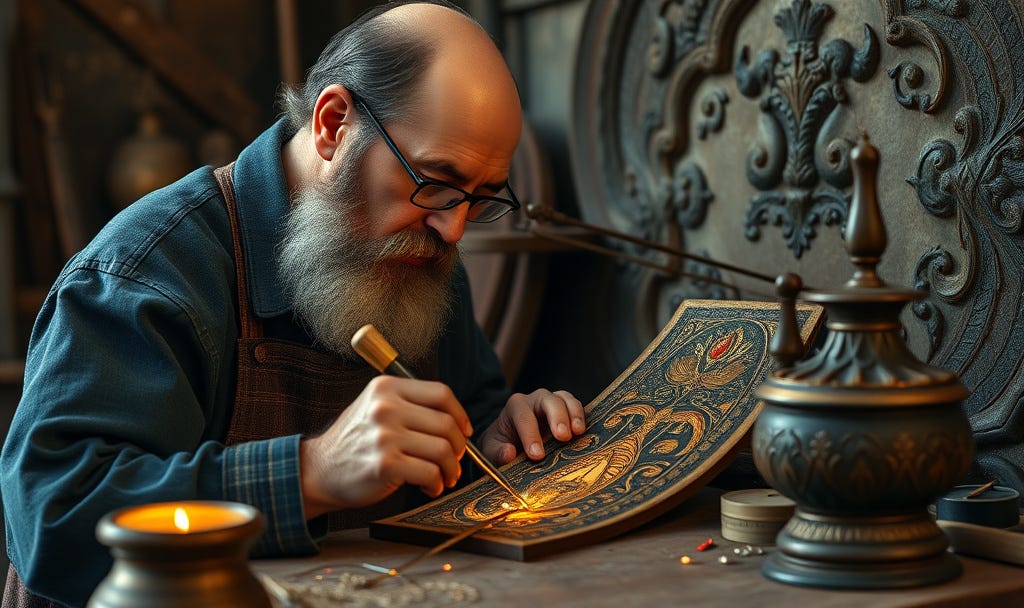
It’s a familiar innovation story in its own right: a core market disappears, and the question becomes whether deep, hard-won expertise can find a second life somewhere else entirely. For Toledo, the answer was yes. The smiths’ knowledge — like their sword blades — proved malleable, and they turned their skills to a more peaceable purpose. The ancient art of damasquinado — creating intricate patterns by hammering gold and silver threads as inlay into steel — had arrived with the early Moors. A technique originating in Damascus, as the name suggests, it was always highly prized, and it gave the Toledo craftsmen a valuable new outlet just as their old market was vanishing. The same hands that had spent two centuries perfecting the tension between hardness and flexibility in a blade now turned that same precision to ornament rather than edge.
A tour of the city today brings this history to life. Of course you’ll find countless souvenir shops selling replicas of Toledo blades, but you can also browse other sites selling exquisite damascene artwork. And in the quieter older parts of town, you might still catch a whiff of smoke or hear the tap-tap of a jeweller’s hammer, carefully creating such pieces — a throwback to earlier times, when it would have been a blacksmith’s hammer beating highly crafted steel into its legendary shape.
It’s a powerful metaphor for successful innovation. The swords themselves were forged from a steel that represented a perfect composite of strength, hardness, and flexibility, conferred through deep understanding of many metallurgical traditions. They resolved the blacksmith’s dilemma — trading off strength and sharpness against flexibility — by finding an integrated solution instead of picking a side.
Their unique metalworking skills could only emerge from a similar integration: a bringing together of rich and diverse cultural and technological traditions. The city’s architecture still reminds us what can happen when different cultures converge and interact — the Muslim, Jewish, and Christian worlds colliding not to explode and shatter, but to combine.
Toledo steel is, in essence, an admixture: a coming together of differences to create something that brings out the best of all of them. Real swords, it turns out, didn’t need elven magic—just eight centuries of competing knowledge traditions forced to share a city.
You can listen to a podcast of this story here
And watch a video version on my YouTube channel here
If you’d like more songs, stories and other resources on the innovation theme, check out my website here
And if you’d like to learn with me take a look at my online courses here
All images generated by Substack AI unless otherwise indicated