
Blowing innovation bubbles....
The 150-year overnight success story of the humble dishwasher


I’ve been spending a lot of time over the past couple of days washing up. Old school. Rubber gloves halfway up my arm, scrubbing brush or dishcloth in hand, trying to fight my way through the accumulated debris of another family meal.
The reason I’m stood, 1950s style at the sink, is that our dishwasher has gone on strike. All I get are surly messages through the liquid crystal display suggest its dissatisfaction and the desire for a few days off plus a service.
My sink-side posture reminded me of a (possibly fictitious) story about Alastair Pilkington, inventor of the float glass process by which most of the world’s windows today are made. Legend has it that while he was daydreaming, like me, at the sink he noticed the way a dinner plate floated on the surface of the water and imagined the possibility of doing the same with molten glass. Floating it carefully on top of the water and setting like a layer of skin on its surface. He surmised that underneath the skin would be perfectly flat, perfectly smooth – exactly the characteristics needed to make glass for window panes.

Whilst I’m happy to acknowledge the possible value of a soapy sink as an aid to brainstorming, my experience is that doing the washing up by hand is a clear cut case of necessity screaming out loud for some serious procreation!
I’m not the first to want some assistance; creating a machine to take out the drudgery has been on the innovation agenda of a lot of people for a long time. The earliest aids were brushes, mops and other hand-wielded devices which made for easier separation of the dirt and waste from the surfaces.
But the first recorded invention of a machine to do the job was probably the patent filed by Joel Houghton in 1850 in the USA. A wooden machine with a hand-turned crank which sprayed water on to the dishes (and apparently everywhere else). The user would load dishes, heat up some water on the stove and then pour it into the machine. Having loaded it they would then turn the handle with one hand, causing the paddle wheel to hurl water in the general direction of the plates.
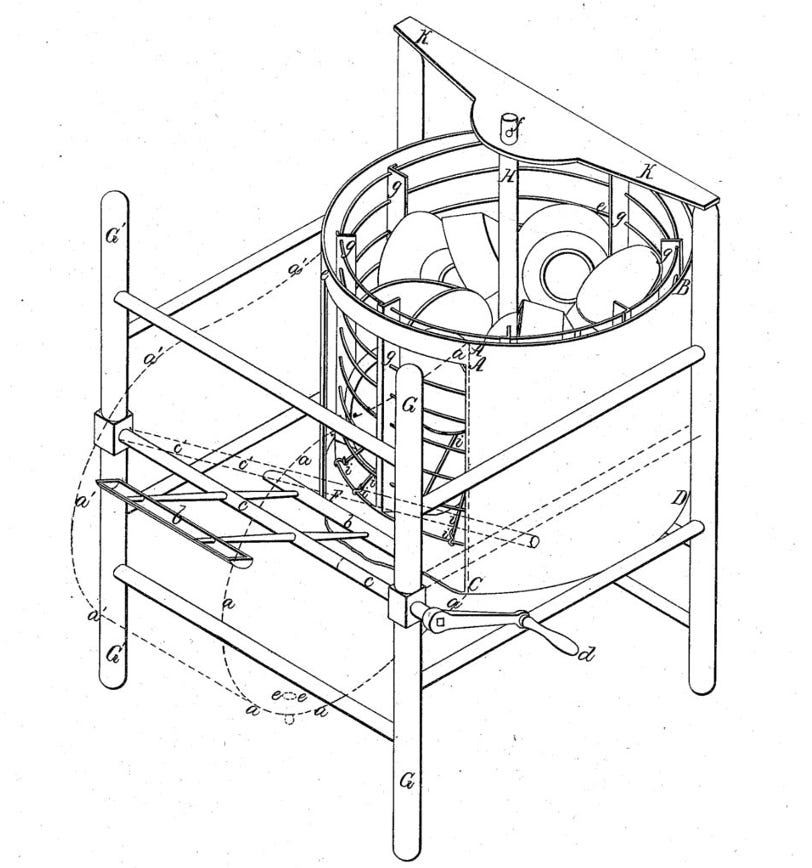
Image credit: United States Patent Office.
It wasn’t very effective, not least because the gentle splashing of a shower of hot water did little to dislodge grease and direct which needed a much more heft scrubbing action. And being made of wood the repeated soaking meant it had a tendency to go mouldy and eventually rot.
It served its purpose though in firing the starting gun on a race to improve on the idea. In 1863 a pair of inventors, Levi Alexander and Gilbert Richards patented a different machine using elements of the original but adding a rack to hold the dishes and a nifty little side compartment through which the user could hold up a dish to a set of revolving sponge arms, using their other hand to turn the handle and spin the sponges. It worked but there was a lot of manual labour involved, not least on carrying water and scrubbing the dishes in a box instead of at the sink.
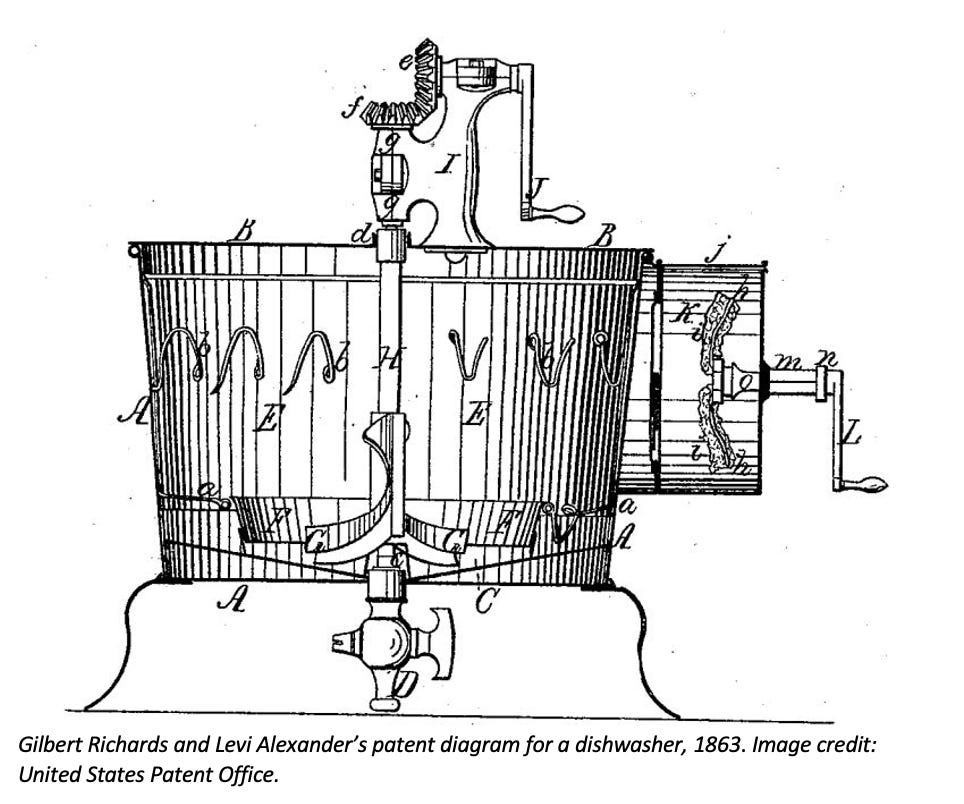
By 1865 Alexander had a brainwave; instead of splashing water on to the dishes he arranged for the dishes to be spun through a tub of hot water. Effective but risky if you put your fine china dinner service in to be hurled around inside a scalding water box with a significant track record of breakages.
By 1888 the US Patent Office had registered over 60 patents for dishwasher designs, most building on the core ideas and improving them. So far a classic innovation pattern; many would-be entrepreneurs arriving at the same conclusion at around the same time. There’s a big opportunity here - if only we can get the innovation right. The result is what is sometimes called ‘swarming’, many different approaches and designs circling the problem like bees around a sugar cube.
None of these devices had much impact and it fell to a wealthy socialite in Shelbyville, Illinois to come up with a significantly better version in 1886. Her motive was less down to labour saving – with an army of servants on standby it’s unlikely that she would have got her hands in the dirty water – but rather a protectionist urge on behalf of her fine china dining service. Together with her husband, a well-connected businessman, Josephine Garis Cochrane was known for throwing fancy dinner parties at their mansion. Inevitably this generated a high volume of dirty crockery but her concern was that the servants hand-washing was often less careful than she wished for, with the result that cups were chipped and plates scratched or cracked.
There must be an alternative, she thought and after searching for possible options decided on a do-it-yourself strategy. She is reputed to have said . “If no one else invents the dishwasher, I’ll do it myself,” – quite an ambition since the thought came at a time when women were rarely allowed to be inventors.
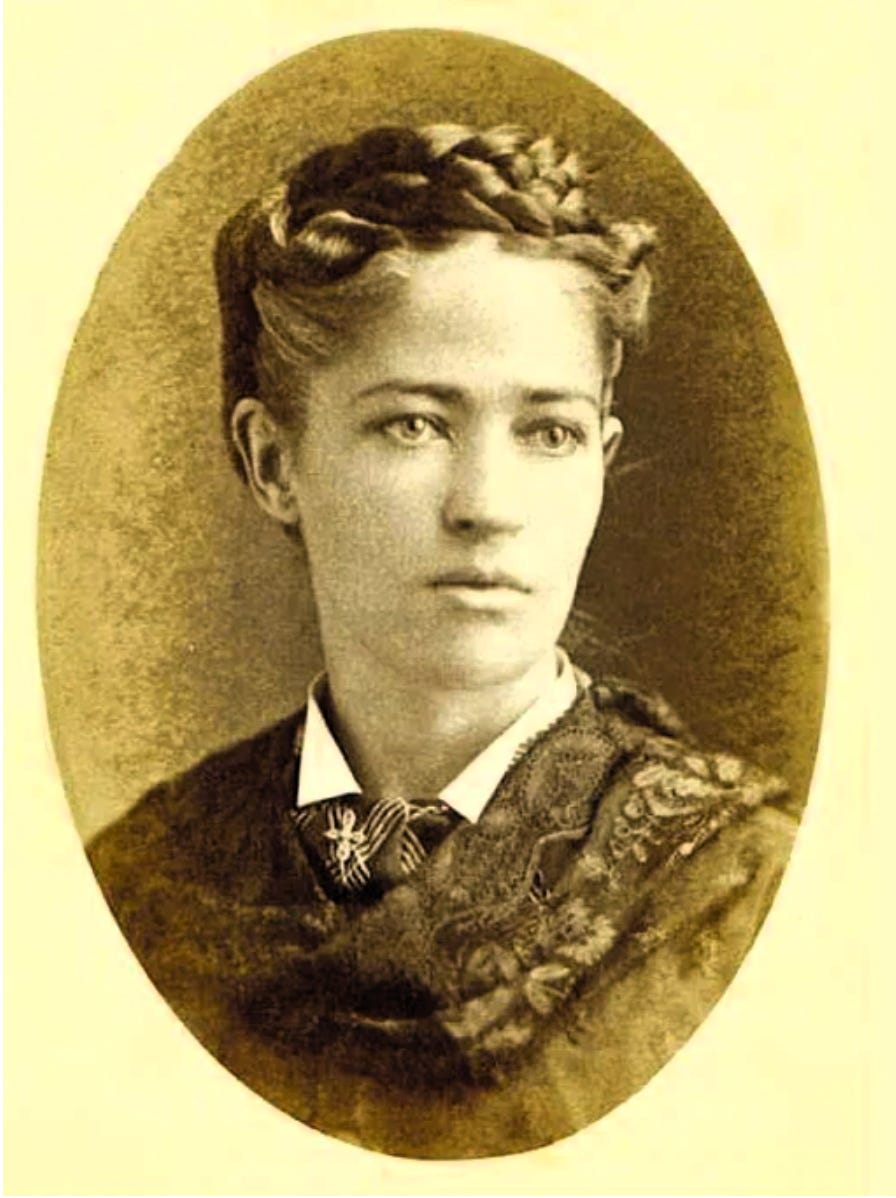
Image: public domain, Wikimedia Commons
Fate, as usual, took a hand and she was widowed early, finding herself at 47 with a mountain of debt. She’d always had a natural talent for problem solving and invention and took an interest in engineering, but like she did not have access to the resources needed to pursue higher education in the subject, as such opportunities were rarely afforded to women at the time. Her debut as an entrepreneur was crisis-driven and seeing her idea as a possible solution. she spent an increasing amount of time working on the problem.
She recruited a local mechanic, George Butters and they beavered away in Cochrane’s tool shed finally coming up with a workable design. She filed for a patent (significantly under the gender neutral name of J.G.Cochrane) and it was granted in 1886.
It consisted of a wooden wheel that lay flat in a copper boiler. A motor turned the wheel while the dishes, fitted in wire compartments, were sprayed with hot soapy water. The machine was loud, rather inconvenient in its handling – but it worked. It also was the first one with racks specifically designed to hold the dishes in place, as well as the first to use water pressure instead of scrubbers. Additionally, Cochran’s design was far more convenient in comparison to previous machines that had required users to pour boiling water over the dishes. And it introduced the idea of different cycles, for washing and then for rinsing the scrubbed dishes.
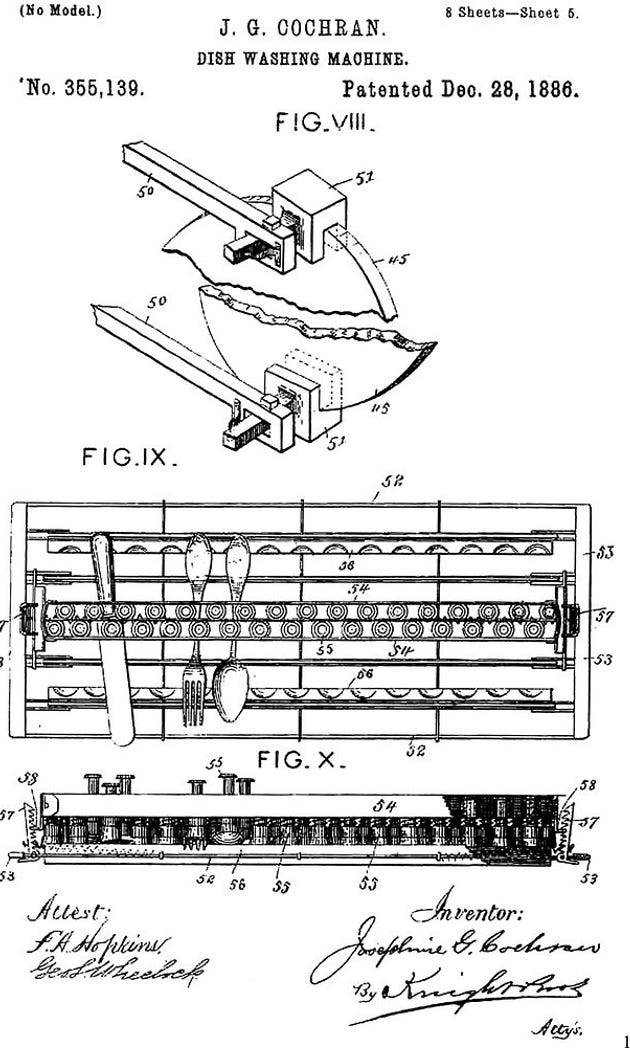
Their machine effectively created the architecture for the modern dishwasher, again underlining a key innovation lesson. After a period of ‘swarming’ where many ideas and players are in the mix things settle around a ‘dominant design’. Not necessarily the most technically advanced or the cheapest, or the cleverest – but the one which seems to fit the market opportunity best. Where the value proposition best matches the target market needs.
In all she was granted seven patents over the following years for improvements and different designs. She’d moved the innovation from being a simple box substituting for the kitchen sink and instead offered a dishwashing system. The racks were carefully designed to hold the dishes in place and stop breakages (her first prototypes were based on precise measurements of her own precious china). The water was heated separately and then pumped at high pressure to blast dirt off instead of scrubbing it. And the wash/rinse cycles meant that the finished dishes merely had to be unloaded and left to dry.
She wasn’t content with inventing the product; she also took its manufacturing seriously. At first she tried getting contract manufacturers to produce them for her but was dissatisfied with their results. So she eventually decided to set up her own facility near Chicago, putting Butters in charge.
She is reputed to have said;’ “I couldn’t get men to do the things I wanted in my way until they had tried and failed in their own. And that was costly for me…… they knew I knew nothing, academically, about mechanics, and they insisted on having their own way with my invention until they convinced themselves my way was the better, no matter how I had arrived at it.”
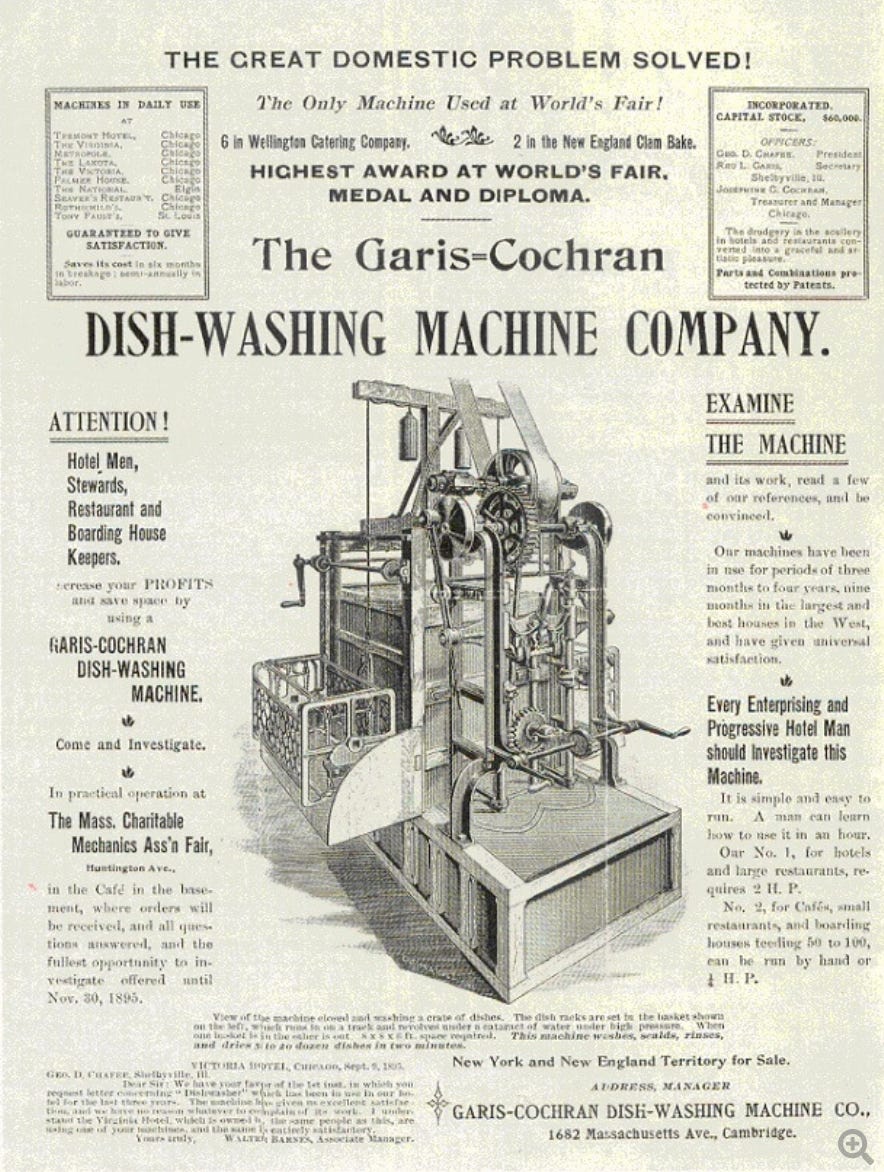
And she energetically threw herself into marketing the product, travelling throughout the mid-West to demonstrate it. In 1893 she exhibited ‘the Lavadora’ at the Chicago World’s Fair, showcasing her machines in the Machinery hall and Women’s Building but also, cannily, making sure they were actually being used in some of the fairground’s on-site restaurants. She came away with an award for her design – but more important a fistful of orders.
She continued to develop the product; by 1894 she’d taken advantage of the nascent electricity revolution to replace hand operation with a small electric motor to drive the machine. And in 1903 she replaced the separate hot water boil and feed system with a pipe connecting to a running hot water supply.
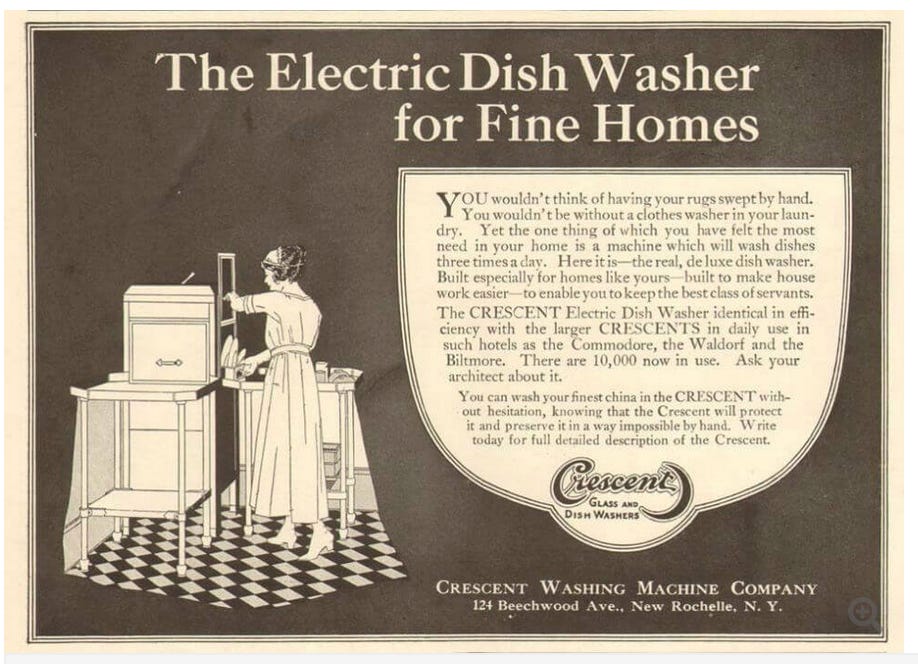
She realised early on that although women would love to own one of her machines and avoid a little of their domestic drudgery the price was far out of their reach. In 1911, for example, a machine would cost around $350, equivalent to $12,000 in today’s money. However the potential labour savings in restaurants, hotels, hospitals and other industrial scale washing up sites meant that it was a different prospect. The larger industrial model could wash an impressive 240 dishes in two minutes.
The barrier to large-scale domestic use wasn’t just financial; there was also a technical problem. Most houses boiled water on the stove and even when small electric water heaters began to appear their capacity was too limited. At the turn of the twentieth century less than 10% of US households had electricity and fewer had piped hot water. So diffusion was slowed despite a market eager to adopt the product; sadly she died in 1913 before being able to see dishwashers become a core appliance in the nation’s kitchens.
Her groundwork paved the way other improvements though the core design principles which she established meant hers became the ‘dominant design’ for appliances. Manufacturers began to see the possibilities; in Europe the Miele company introduced the first electric dishwasher in 1929; unfortunately its arrival on the market coincided with the Great Depression which held back sales somewhat!
Other inventors added key features, in particular William Livens, working in the UK. His contributions, expressed in his 1924 patent included the front-loading door and rotating spray arms. By 1940 he’d also added a drying capability, effectively completing the system which Josephine had imagined sixty years earlier.
In parallel with the dishwasher itself another innovation stream was in play, in the area of detergent development. Back in the days of hand scrubbing human dishwashers made use of sand and other materials to help shift the grease and dirt. The development of soap with its properties as a surface active agent improved on this, chemically assisting the removal of fats which held the dirt on the plates. So not surprising early dishwashing machine experiments deployed soapy water in their systems. Unfortunately throwing hot soapy water at plates being whirled around in various configurations led to predictable results – an explosion of suds spilling out through every gap and crevice and creeping like lave across the kitchen floor!
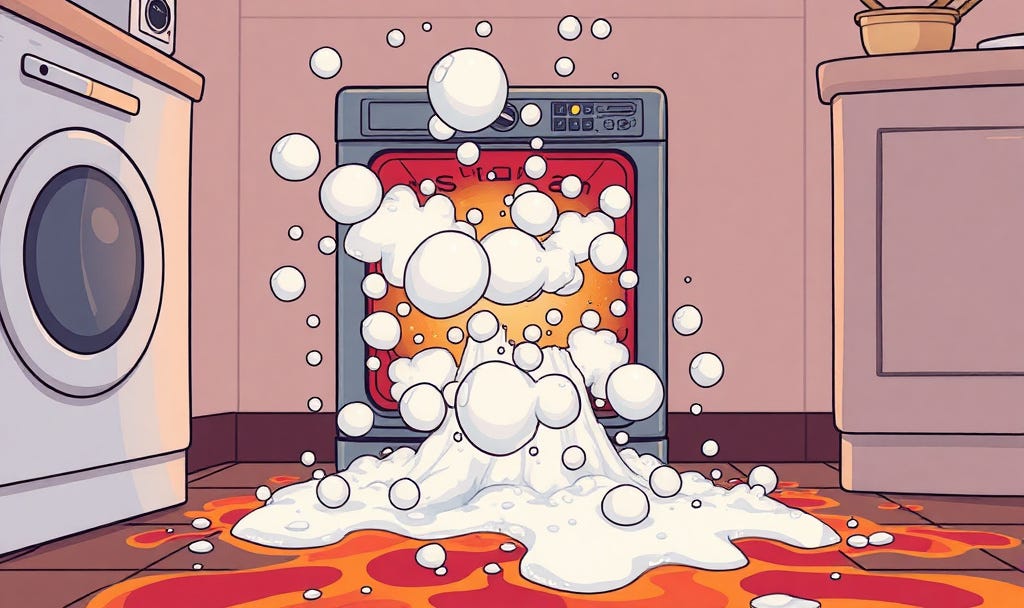
It wasn’t until the 1930s with the development of synthetic surfactants that the problem of foaming was solved. The growing rearmament pressures in Europe led to research around replacing glycerine (a key fat used in soap but also in explosives) with synthetic substitutes. Detergents like ‘Dreft’ and ‘Tide’ made their debut during the Second World War and provided another key with which to unlock the potential in the mass market for dishwashers.
Chemistry also played another role in solving problems which dogged early dishwashers. Although scrubbed clean of their grime dishes often emerged in a worse state then they had gone in because the washing process led to deposits of magnesium or calcium being left as a cloudy film on their surface. This related to ‘hard’ water present in many places; such mineral rich water reacted with the soap to create a kind of residual scum.
In 1926 researchers for the Hagan Corporation in Pittsburgh were working on the hard water problem to prevent build up of scale in industrial boilers. They developed a product which was refined and later marketed in 1933 under the brand name ‘Calgon’ – calcium gone – which became the first widely available water softener for home use. Applications were extensive, including bathing, clothes washing – and of course, dishwashers. Such softeners quickly became part of the standard dishwasher recipe along with detergent powder.
By the post-war years the domestic infrastructure of electricity and hot water systems had caught up such that there was huge expansion in diffusion to this market. The pattern involved moving the dishwasher from an expensive ‘status symbol’ purchase in the 1950s to becoming a mainstream kitchen appliance; by 1960 around 7% of US households owned one. Continuing market expansion led to many refinements to adapt to the needs of different market segments – for example making standard sized machines to fit next to cupboards and under worktops as modular units in kitchens increasingly planned as a system. Current estimates suggest that close to 80% of households in North America and parts of Europe have dishwashers with the global average penetration close to 50%.
Development continues in areas like energy saving and sustainable water use, deploying intelligent sensors to match multiple washing program options to demand. The age of the robot dishwasher is definitely upon us – although the scientific jury remains out in respect of answering the question of the optimum method for stacking dishes inside it.
It isn’t just about cleaner plates; one of the biggest impacts of the dishwasher has been its contribution to saving time. In 2010 the estimated average time in US homes spent on household chores was around 18; in 1965 it was closer to 34 hours. Whilst dishwashers don’t account for all of that difference there certainly seems to be a correlation with dishwasher ownership, growing from around 14% in 1865 to over 70% in 2010.
And research suggests that there may be other benefits; a group of US utilities estimated that washing dishes by hand used three times as much energy and seven times as much water as running them through a dishwasher. So if you want to save the planet a helpful first step might be to invest in a dishwasher!

Innovation might appear to be the province of lone genius but the reality is that this ‘great man’ – or woman – theory doesn’t hold up. Instead it’s much more like a river system, with many tributaries gradually coming together and building momentum. Little springs and rills and rivulets converging and cascading into what becomes a mainstream.
Arguably the dishwasher as an innovation didn’t suddenly happen in 1886. It was pieced together over a century and a half by, amongst others by a socialite who hated broken china, a weapons engineer who understood spray, and chemists who accidentally solved the problems of blocked up boiler tubes in factories and too many soapsuds on the floor.
But we should also acknowledge there are key points when the river gets real impetus, flows faster, is borne by a powerful current. And Josephine Cochrane certainly supplied that. Maybe she’s not as famous as Thomas Edison but she shares a lot with him in terms of her ability to see innovation as an all-round problem, not just a clever product idea. Thinking through the system needed to make, sell, distribute and continuously improve on her original design plus her deep understanding of different users and the context in which her innovation would operate – all that marks her out as an innovation legend.
It took a lot of effort, no quick wins. She was a persistent inventor, manufacturer and salesperson, and she continued to develop and patent improvements on her invention throughout her life. Reflecting on her innovative journey, she said, “If I knew all I know today when I began to put the dishwasher on the market, I never would have had the courage to start. But then, I would have missed a very wonderful experience.”
And I’d be stuck with my arms in soapy water a lot more than I planned for…!
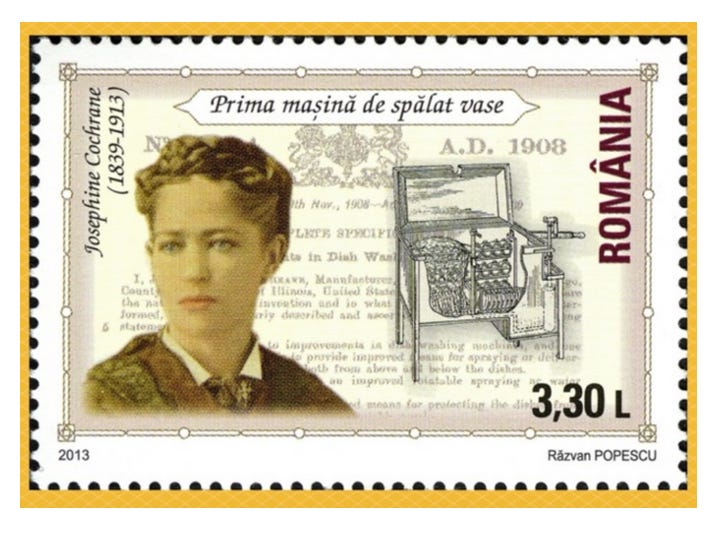
So I owe her a big debt. But not just me; there are millions of others grateful for her contribution. Not least the Romanians who, in 2013 saw fit to issue a commemorative stamp with her portrait on it.
Me – I’d put a statue up to her.
You can listen to a podcast of this story here
And watch a video version on my YouTube channel here
If you’d like more songs, stories and other resources on the innovation theme, check out my website here
And if you’d like to learn with me take a look at my online courses here
All images generated by Substack AI unless otherwise indicated
What looks obvious today usually took decades of messy iteration, dead ends, and people stubborn enough to keep improving something everyone else thought was good enough
very inspiring story.